
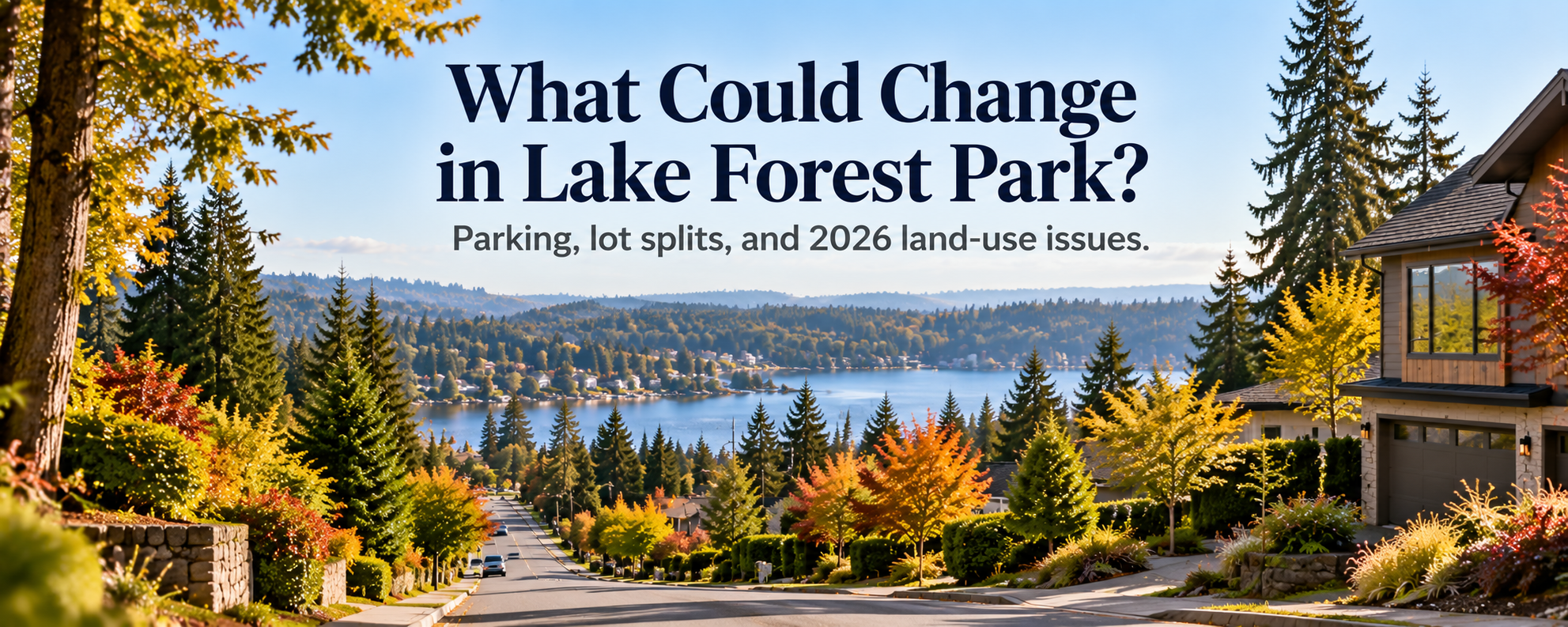
Lake Forest Park has plenty of properties that look promising on a parcel map.
A half-acre lot. A deep backyard. An older house sitting toward one end of the property. In another city, it might immediately raise the question: could this become two lots, a pair of townhomes, or something denser?
In Lake Forest Park, the answer is rarely that simple.
The city’s large residential lots are mixed with steep slopes, mature tree canopy, streams, wetlands, winding roads and properties that were never designed around intensive development. At the same time, Washington has been steadily pushing cities to accommodate more housing.
Those two forces are beginning to meet.
Lake Forest Park made significant housing-code changes in 2025. Now the City is considering another group of land-use issues for 2026, including parking requirements, lot splits, subdivision rules and development around future high-capacity transit.
The important word is considering.
Many of the issues attracting attention have not yet become new local rules. For homeowners, the interesting question is not simply what could change, but what is actually allowed today and what remains under review.
Parking Could Become a Bigger Part of the Housing Conversation
Parking may sound like one of the less consequential parts of zoning.
In practice, it can determine how much housing fits on a property.
Lake Forest Park’s 2026 Planning Commission work plan includes a review of parking ratios for different housing types, from lower-density residential development to apartments and other multifamily projects. The work plan also leaves open the possibility of studying reductions or elimination of some parking minimums if directed by the City Council.
That matters because parking consumes land.
A project that has to provide two spaces for every unit can look very different from one allowed to provide fewer spaces, particularly on smaller or oddly shaped parcels.
Reduced parking requirements could make some development easier near transit or commercial areas.
But that is still a possibility, not the current rule.
That distinction is important whenever zoning discussions start influencing how people talk about property values. A parcel should not be priced as though a proposed rule already exists.
Lot Splits May Be the Bigger Question for Many Homeowners
For Lake Forest Park, lot splitting may be the issue with the most obvious homeowner interest.
Washington passed HB 1096 in 2025, creating a framework intended to make some residential lot splits easier. Lake Forest Park has corresponding local code work on its 2026 agenda.
That naturally gets attention in a city where relatively large lots are common.
Someone with a deep 20,000-square-foot parcel may look at it and wonder whether a portion could eventually become another homesite.
Sometimes that may be possible.
But lot size alone does not answer the question.
A Big Lot Is Not Necessarily a Buildable Lot
This is where Lake Forest Park becomes particularly interesting.
Its tree canopy and topography are some of the things residents value about the city. They are also part of what makes development complicated.
A property can contain enough square footage for another lot on paper while having much less usable land once you account for:
-
Slopes
-
Streams
-
Wetlands
-
Critical-area buffers
-
Tree requirements
-
Setbacks
-
Access
-
Utilities
-
Lot configuration
A half-acre property crossed by a stream or located on a steep slope can have dramatically different development potential from a flat half-acre property on a conventional street.
HB 1096 does not make those constraints disappear. Lake Forest Park’s local development regulations still matter.
That is why the question “Can this lot be split?” usually requires a property-specific answer rather than a citywide yes or no.
Existing Homes Could Still Remain Existing Homes
More development capacity does not mean established Lake Forest Park neighborhoods suddenly disappear.
If local rules eventually make a property easier to subdivide, the homeowner is not required to do it.
A detached house can remain exactly what it is.
The difference shows up when someone eventually sells or redevelops.
A buyer looking for a home may value the yard, privacy and trees.
Another buyer may look at the exact same property and focus on its dimensions, access, zoning and possibility of creating additional lots.
Both can be legitimate ways of valuing the property.
The challenge is knowing whether the second scenario is actually feasible rather than merely theoretical.
Transit-Oriented Development Adds Another Layer
Lake Forest Park is also working through how state transit-oriented development requirements may interact with future Stride bus rapid transit service.
State legislation adopted in 2025 requires certain cities to accommodate additional housing around qualifying transit stations. Lake Forest Park is studying what that means locally, including how transit-oriented development may interact with parking requirements.
That does not mean every property near future transit is suddenly eligible for a large apartment building.
It means another set of development rules may eventually apply to particular areas.
The City has created information about its work with Sound Transit on the City of Lake Forest Park website.
At the same time, transportation projects are already physically changing parts of the city. The source draft notes that retaining-wall work on the SR 104/NE 40th Place Roundabout Project began in September 2026 alongside temporary utility relocations.
So there are really two different stories unfolding.
One is visible infrastructure.
The other is the slower process of deciding what kind of housing should eventually surround that infrastructure.
Transit Can Affect Development Without Automatically Increasing Every Home’s Value
It is tempting to turn any transit investment into a simple real estate equation:
Transit arrives. Density increases. Property values go up.
Real life is messier.
A property close to high-capacity transit may become more interesting to a developer if zoning allows more housing there.
Another homeowner may value the area less if future development changes traffic, privacy or neighborhood character.
And a parcel may technically gain development capacity without being economically practical to redevelop.
That is why potential zoning changes are useful information, but they should not be treated as a guaranteed increase in value.
Development economics still have to work.
Subdivision Rules Are Also Being Revisited
Lot splitting is not the only subdivision issue on Lake Forest Park’s 2026 agenda.
The Planning Commission work plan also includes broader updates to subdivision regulations, including rules involving short-plat expiration.
That may sound technical, but it can matter for an individual property.
An owner may discover that a previous owner explored subdividing years ago. There could be an old application, preliminary approval or other record associated with the parcel.
Before assuming that work is still valid—or worthless—it is worth checking the property's history.
For unusual parcels, older short plats and previous development applications can sometimes tell you almost as much as the current zoning designation.
The Most Important Distinction: Three Different Sets of Rules
The easiest way to understand Lake Forest Park’s current land-use discussion is to separate it into three layers.
First, there is state law.
Washington has adopted housing legislation that cities must respond to, including newer rules involving lot splits and transit-oriented development.
Second, there is what Lake Forest Park is currently considering.
Parking ratios, local lot-split implementation, transit-oriented development standards and subdivision changes are among the issues being studied.
Third, there is what has actually been adopted into Lake Forest Park’s municipal code.
That third category is what governs a property today.
The three often get blended together in casual conversation.
“They're changing the zoning.”
“You'll be able to split this lot.”
“This whole area is going multifamily.”
Sometimes there is a real policy proposal behind those statements.
That does not mean the proposal has become law.
What About the Housing Changes Lake Forest Park Already Made?
The 2026 discussion is not happening from scratch.
Lake Forest Park already changed parts of its housing code in 2025.
Those earlier changes included new rules addressing additional housing types and development options. The 2026 work represents another stage of the broader housing discussion rather than the beginning of it.
That distinction matters because homeowners can easily encounter information about a proposed 2026 change alongside a rule that was actually adopted in 2025.
One is current law.
The other may still change substantially before adoption.
What Should Someone With a Large Lake Forest Park Lot Do?
Start with the property rather than the headline.
Look at:
-
Current zoning
-
Lot dimensions
-
Access
-
Critical areas
-
Slopes
-
Streams or wetlands
-
Trees
-
Utilities
-
Existing structures
-
Prior subdivision or permit history
Then determine what is possible under today's rules.
Only after that does it make sense to consider what proposed changes might add.
This is particularly important if you are thinking about selling.
A traditional homebuyer and a developer may place very different values on the same property, but development potential should be supported by something more substantial than speculation.
If you're trying to establish a listing strategy, I would still start by pricing based on what the current code allows and treat plausible future changes as additional context.
Could a Lot Split Make a Property More Valuable?
Potentially.
But not simply because the lot is large.
Suppose two homes sit on otherwise similar half-acre properties.
One is relatively flat, has straightforward street access and utilities, and contains no major critical areas.
The other slopes steeply toward a stream and contains substantial protected vegetation.
They may have the same lot size in the listing data.
Their subdivision potential could be completely different.
That is why blanket rules such as “large lots are worth more to developers” are not particularly useful in Lake Forest Park.
The details matter too much.
What About Properties Near Stride?
Those are worth watching.
If state transit-oriented development requirements ultimately result in greater housing capacity around qualifying transit areas, some nearby parcels could become more interesting for redevelopment.
But location near transit is only one variable.
The eventual zoning, parcel dimensions, access, parking standards, construction costs and allowable building form will all influence whether a project is actually viable.
There can be a considerable gap between theoretically allowing more housing and having a developer ready to build it.
Frequently Asked Questions
Have Lake Forest Park’s parking rules already changed in 2026?
According to the source draft, no.
Parking ratios are among the items on the City's 2026 Planning Commission work plan. Potential reductions are being considered, but the draft does not describe them as adopted rules.
Can I split my Lake Forest Park lot now?
Possibly, but not simply because it is large.
State legislation has changed the broader framework for lot splits, while Lake Forest Park is working through its local implementation.
Critical areas, access, utilities, setbacks and other development standards still matter.
A property-specific feasibility review is the reliable way to answer the question.
What is Stride BRT?
Stride is Sound Transit's bus rapid transit program.
Lake Forest Park is studying how state transit-oriented development requirements could interact with future transit service and local land-use rules.
Does being near future transit mean my zoning has already changed?
No.
Transportation construction, state requirements, City planning and adopted zoning are separate stages of the process.
A future transit station does not by itself tell you exactly what can be built on a nearby parcel today.
Can trees prevent a lot from being divided?
Trees can be one of several significant constraints.
Lake Forest Park also has slopes, streams, wetlands and other critical areas that can reduce the portion of a property available for development.
The answer depends on the specific site.
What if an old owner already started a subdivision?
Check the records.
The property may have an earlier short-plat application or approval associated with it. Lake Forest Park is also reviewing some subdivision and expiration rules, so the status of older work can be important.
Should I wait for the 2026 rules before selling?
There is no universal answer.
Waiting makes more sense when there is a realistic reason to believe a specific pending change will materially affect the property and when the owner is comfortable with the uncertainty and timing involved.
Selling under today's rules provides more certainty.
The important thing is not to price today's property entirely around a future rule that may change before adoption.
The Bottom Line
Lake Forest Park is an unusual place for this particular housing debate.
It has large residential lots and valuable land close to Seattle.
It also has hills, streams, extensive tree canopy and neighborhoods shaped by the landscape rather than a conventional street grid.
Now another ingredient is being added: state pressure for more housing and more development around transit.
That does not mean Lake Forest Park is about to become unrecognizable.
It does mean the rules determining what can eventually be built here are changing.
For homeowners, the most useful approach is to keep the categories straight.
Know what Washington requires.
Watch what Lake Forest Park is considering.
And make decisions based primarily on what the adopted code actually allows today.
The difference between those three can be substantial—and on the right property, it can also be worth a substantial amount of money.