
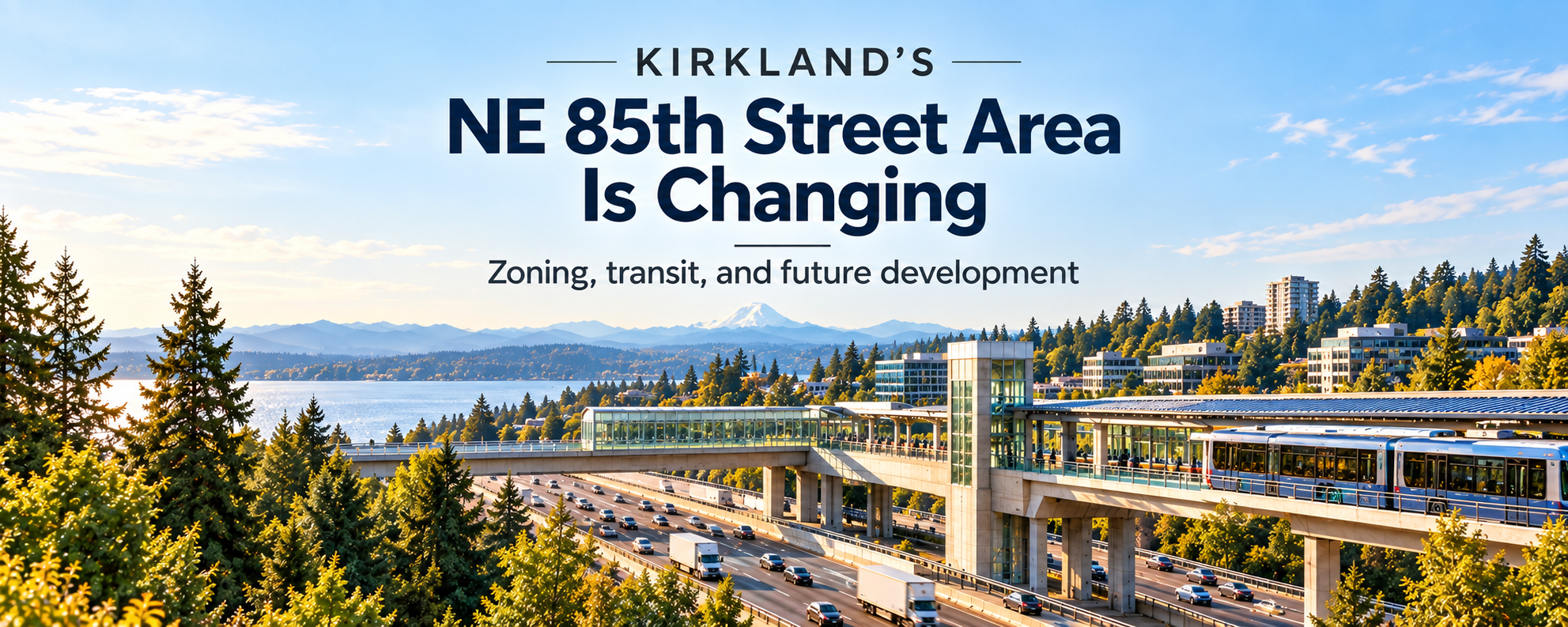
What is changing around Kirkland's NE 85th Street, and what could it mean for homeowners, buyers, sellers, and the surrounding neighborhoods?
The NE 85th Street Station Area is in the middle of a major transformation. The interchange at I-405 is being rebuilt, new regional transit is coming, and Kirkland has changed the zoning around the station to accommodate substantially more housing, employment, and mixed-use development over time.
Some of these changes are already highly visible. Others may take years or even decades to fully take shape.
For anyone who owns property in or around the Station Area, the important thing is understanding the difference between what is happening now, what the zoning allows in the future, and what remains only a long-term possibility.
Why This Matters Right Now
Anyone who has driven through NE 85th Street and I-405 recently has seen the construction. But the new interchange is only one piece of a much larger plan.
The City has designated the NE 85th Street Station Area as one of Kirkland's primary locations for future housing and employment growth. The long-term goal is to gradually transform an area currently made up of homes, offices, shopping centers, schools, industrial properties, and other uses into a denser and more walkable district centered around regional transit.
The planning framework has also continued to evolve. Kirkland adopted another significant round of zoning amendments in May 2026, while the new interchange and transit station are expected to begin opening in 2027.
For property owners, that makes this a useful time to understand how the area is changing rather than waiting until redevelopment is already happening next door.
What Is the NE 85th Street Station Area?
The Station Area is centered on the I-405 and NE 85th Street interchange and extends into portions of several surrounding Kirkland neighborhoods.
The Kirkland City Council adopted the NE 85th Street Station Area Plan in 2022, followed by additional zoning and development regulations.
You can review the City's Station Area planning information here:
Kirkland NE 85th Street Station Area Plan
The long-term vision is considerably different from what exists around much of the interchange today.
Kirkland is planning for a mixed-use district containing housing, jobs, shops, services, parks, and improved connections for people walking, biking, and using transit.
That does not mean the entire area is about to be rebuilt.
Zoning establishes what can be developed as individual properties change hands or owners decide to redevelop. Some sites may change relatively soon, while others could remain essentially as they are for many years.
How the New Zoning Works
Kirkland uses a form-based code for much of the Station Area.
Rather than focusing only on what type of use is permitted on a property, form-based zoning also regulates characteristics such as building height, massing, placement, frontage, and how new development interacts with streets and public spaces.
The Station Area includes districts such as Commercial Mixed Use and Neighborhood Mixed Use, with different development standards depending on location.
Some zoning designations also include both a base height and a higher maximum that may be available when a project provides qualifying public benefits or meets incentive requirements.
That means two properties containing similar homes today could have very different redevelopment potential depending on their underlying zoning.
For owners considering selling, this is one reason it can be important to understand the land as well as the house sitting on it.
120th Avenue NE Is Planned as a Main Street
The Station Area Plan identifies 120th Avenue NE as a future Main Street.
The City's vision includes more pedestrian-oriented development along this corridor, including active ground-floor uses such as shops, services, restaurants, and other businesses.
This is a good example of how the Station Area Plan is about more than simply increasing building heights.
The broader objective is to gradually create a neighborhood where housing, employment, businesses, transit, and public spaces are more closely connected.
The May 2026 Zoning Changes
Kirkland adopted another set of Station Area zoning amendments on May 5, 2026, which took effect May 16.
One of the most consequential changes generally prevents new low-density housing development in most of the Station Area, with limited exceptions in portions of the lower-height Neighborhood Mixed Use district east of 124th Avenue NE.
That change reinforces the City's goal of encouraging greater housing and employment density near the future transit station.
What This Does Not Mean
It does not mean an existing house suddenly has to disappear.
Existing homes can continue to be used and sold.
The zoning becomes particularly important when someone proposes new development on the property. At that point, what replaces the existing use generally needs to comply with the Station Area's current development regulations.
For many homeowners, therefore, the practical effect may be gradual rather than immediate.
Development Agreements Add Another Layer
The 2026 amendments also expanded the potential use of development agreements within the Station Area.
A development agreement is a negotiated arrangement between a developer and the City. In certain circumstances, it can consider building heights or uses beyond what would otherwise be permitted under the property's standard zoning.
That does not mean a developer can simply ignore the zoning code. These agreements go through their own City review and approval process.
But it adds another layer to understanding the redevelopment potential of larger or more complicated properties.
For a homeowner considering selling, especially on a parcel with significant development potential, this is why pricing a property solely by comparing it with nearby houses may not always tell the entire story.
I've written more about the broader pricing question here:
What Actually Helps a Seller Get the Highest Price
The I-405 and NE 85th Street Interchange
The most visible part of the transformation is the work happening at I-405.
WSDOT and Sound Transit are replacing the existing interchange with a three-level design incorporating a new inline bus rapid transit station, direct connections to the I-405 express toll lanes, reconstructed local streets, and improved pedestrian and bicycle connections.
Construction began in 2023.
The new interchange is currently expected to begin opening to traffic in 2027, with additional work continuing afterward.
This infrastructure is important because much of Kirkland's land-use planning around NE 85th is based on creating a significant regional transit connection at this location.
When Will Transit Service Begin?
The station is being constructed for Sound Transit's future S2 Stride bus rapid transit line.
S2 will eventually connect Bellevue and Lynnwood through the I-405 corridor, including a stop at NE 85th Street.
Full S2 service is currently scheduled for 2029.
Transit service at the station could begin earlier, however. Sound Transit's proposed service plans include using the new station for existing regional bus routes before the full Stride system opens.
That means there will likely be several phases to the transportation change:
The interchange itself opens.
Existing bus service begins using the station.
Full Stride bus rapid transit service eventually begins.
The surrounding neighborhood then continues developing around that infrastructure over a much longer period.
What About Parking at the Station?
The NE 85th Street station is not planned around a traditional large Park-and-Ride.
Instead, the design emphasizes regional transit connections, walking, biking, local transit, and pick-up and drop-off access.
That decision is consistent with the City's larger Station Area strategy.
Rather than building a destination primarily for commuters who drive to a parking garage and immediately leave the neighborhood, the long-term goal is for more people to live, work, shop, and travel within the area itself.
What Does This Mean for Nearby Property Owners?
For most homeowners, the answer depends heavily on the specific property.
The first thing to understand is the property's zoning.
A house located on a parcel with substantial mixed-use development capacity can be a different real estate asset from an otherwise similar house on a conventional residential lot.
That does not automatically make one more valuable than another.
Redevelopment potential depends on many factors, including parcel size, shape, access, neighboring properties, construction economics, zoning requirements, and whether assembling multiple parcels is necessary to make a project practical.
But it can change who may be interested in buying the property.
A Property May Appeal to Different Types of Buyers
Most homeowners naturally think about selling their property to another person who wants to live there.
In portions of the Station Area, there may eventually be another potential buyer: someone evaluating the land for redevelopment.
Those two buyers may look at the same property very differently.
The homeowner may care primarily about bedrooms, condition, yard size, schools, and neighborhood character.
A developer may care more about parcel dimensions, zoning, allowable height, access, adjacent ownership, and the economics of a future project.
That does not mean every property in the Station Area is suddenly a development site. Many will continue trading as normal residential properties.
It simply means redevelopment potential is another factor worth investigating before determining how a property should be marketed and priced.
For sellers trying to evaluate the right pricing strategy, this article may also be useful:
3 Ways to Price Your Home When Selling
Does the Transit Timeline Affect When Someone Should Sell?
Potentially, but there is no universal answer.
It can be tempting to assume that waiting until the new station opens will automatically make every nearby property more valuable.
Real estate rarely works that cleanly.
A property could benefit from improved transit access while simultaneously facing additional development nearby. A parcel's redevelopment potential may become more important over time, while another buyer may prefer the neighborhood in its current form.
Market conditions, mortgage rates, the property's condition, competing inventory, and a seller's own plans can easily matter more than the opening date of a transit station.
The useful question is not simply whether the neighborhood will change.
It is how those changes interact with the particular property.
Walking, Biking, and Other Infrastructure
A denser neighborhood requires more than new buildings.
The Station Area Plan includes improvements intended to make walking, biking, and rolling through the district easier, along with transportation and utility upgrades intended to support additional growth.
This is particularly significant around NE 85th because much of the existing area was designed around automobile travel rather than as a compact pedestrian district.
Creating the neighborhood Kirkland envisions therefore requires changes both to private development and to the connections between those properties.
Affordable Housing Is Also Part of the Plan
Kirkland has incorporated affordable-housing requirements and incentives into the Station Area regulations.
The exact requirements depend on the type and scale of a particular project, but the larger goal is to use some of the additional development capacity created around major transit investment to produce both market-rate and income-restricted housing.
That is another reason the development rules can become fairly technical.
A zoning designation tells you part of what could be built, but not necessarily everything a future development would have to provide in order to reach its maximum size or height.
Change Will Happen Gradually
Perhaps the most important thing to understand about the Station Area is that zoning capacity is not the same thing as construction.
The City can allow substantially more development without every property immediately redeveloping.
Property owners still decide whether and when to sell or redevelop. Developers still have to determine whether a project makes financial sense. Financing has to be available. Projects have to go through design, permitting, and construction.
Some parcels may change quickly.
Others may look almost exactly the same ten or twenty years from now.
That is why the Station Area should be understood as a long-term transformation rather than one giant construction project.
Frequently Asked Questions
Does the new zoning mean my house will be demolished?
No.
Existing homes can remain. The zoning primarily governs what may be built when a property is redeveloped.
What is the NE 85th Street Station Area Plan?
It is Kirkland's long-term plan for the area surrounding the I-405 and NE 85th Street transit station.
The vision includes additional housing and employment, businesses, parks, public spaces, and better pedestrian, bicycle, and transit connections.
When will the new NE 85th Street interchange open?
The reconstructed interchange is currently expected to begin opening in 2027, with additional project work continuing afterward.
When will Stride service begin?
Sound Transit's full S2 Stride bus rapid transit service between Bellevue and Lynnwood is currently planned for 2029.
The NE 85th Street station may begin serving other bus routes before full Stride service launches.
How does the new zoning affect my property's value?
There is no single percentage or automatic increase.
The effect depends on the property's exact zoning, parcel characteristics, existing improvements, neighboring parcels, market conditions, and whether redevelopment is economically practical.
For some properties, development potential may become an important part of their value. Others may continue to be valued primarily as homes.
What are CMU and NMU?
They are two types of regulating districts used in the Station Area.
CMU stands for Commercial Mixed Use, while NMU stands for Neighborhood Mixed Use.
Each has different rules governing things such as height, building form, frontage, and permitted uses.
Can a project exceed the normal zoning limits?
Potentially, through mechanisms such as incentive zoning or an approved development agreement.
That does not make additional height or uses automatic. The project would still have to meet applicable requirements and go through City review.
Is there a Park-and-Ride at the station?
The current plan does not include a conventional large Park-and-Ride.
The station is instead designed around transit connections, pedestrian and bicycle access, and pick-up and drop-off functions.
Should I sell before or after the station opens?
There is no universal answer.
The better decision depends on the property, current market conditions, the seller's plans, and whether the property's existing residential use or potential redevelopment value is most important.
For a broader look at factors that can influence that decision:
What Factors Do I Need to Consider When Selling a Home?
The Bottom Line
Kirkland's NE 85th Street Station Area is at the beginning of a transformation that will unfold over years, not months.
Much of the framework is already in place: the Station Area Plan, updated zoning, development regulations, infrastructure planning, and the major transit investment now under construction.
The visible changes today are largely transportation-related.
The longer-term story will be what happens on the properties surrounding that new infrastructure.
Some sites will eventually add housing, businesses, and jobs. Others may remain unchanged for years.
For homeowners, buyers, and sellers in this part of Kirkland, the most useful approach is to understand what is permitted today without assuming every possible future development will actually happen.
And for anyone considering selling property in the Station Area, understanding both the current use and the underlying zoning before setting a price can help make sure the property is being evaluated by the right potential buyers.
If you have questions about a particular Kirkland property or how nearby planning changes may affect a future sale, Chris Byler can be reached at 206-601-8945.