
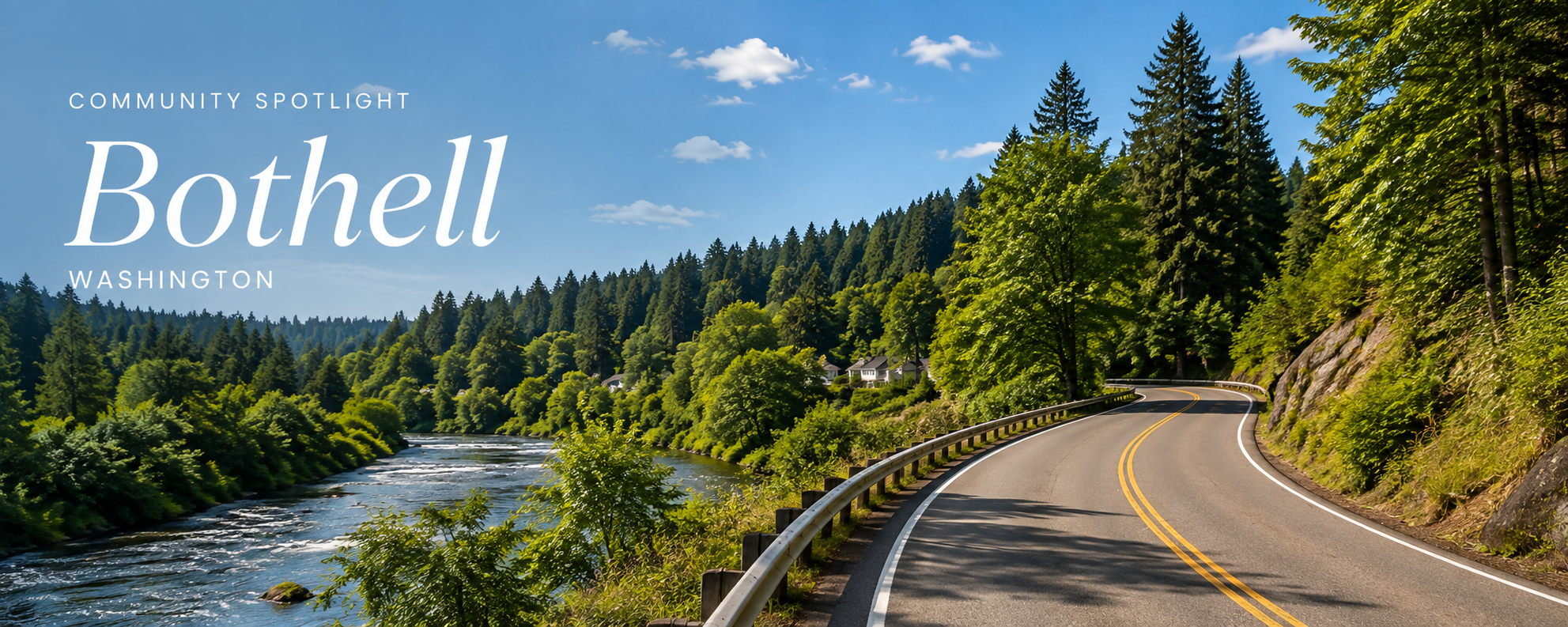
Bothell has changed considerably over the past couple of decades, but it has managed to retain something increasingly difficult to find around the Seattle metropolitan area: a recognizable community center.
Historic Main Street, the Sammamish River, regional trails, established neighborhoods, local businesses and the University of Washington Bothell campus all sit remarkably close together.
The result is a community that can feel surprisingly small-town while still offering convenient access to Seattle, Bellevue, Redmond, Everett and the rest of the Eastside.
Main Street Is Still the Heart of Bothell
Downtown Bothell has undergone substantial redevelopment, but historic Main Street remains an important part of its identity.
The city’s downtown planning has focused on creating a more walkable environment where people can live, shop, eat and gather. Main Street improvements include pedestrian-oriented spaces and flexible areas that allow adjacent restaurants, cafés and retailers to extend activity outdoors.
Rather than being dominated entirely by national chains, downtown includes independent restaurants, coffee shops, specialty retailers and other locally owned businesses.
The city has also experimented with ways to help new entrepreneurs establish themselves downtown.
A Place for Small Businesses to Start
One particularly interesting example is Pop Shops on Main.
The program began in 2021 and provides small retail spaces near Main Street and Bothell Way for emerging businesses. Current vendors include businesses offering artisan chocolates, handcrafted soaps, stationery and other locally produced goods.
It is a relatively small program, but it fits well with the personality of downtown Bothell: established businesses alongside newer entrepreneurs trying something different.
For residents, that means the downtown experience continues evolving rather than feeling static.
Park at Bothell Landing Connects Downtown to the River
A few blocks from Main Street is one of Bothell’s most recognizable community gathering places.
Park at Bothell Landing sits directly along the Sammamish River and includes walking trails, green space, a playground, amphitheater, pedestrian bridge, boat access and several restored historic buildings.
More importantly, the park serves as a connection point.
From there, residents can move easily between downtown Bothell, the river and the regional trail system.
That relationship between downtown amenities and outdoor recreation is one of Bothell’s strongest lifestyle features.
One of the Region’s Best Trail Connections
If you enjoy walking, running or cycling, Bothell occupies an unusually convenient position.
The Burke-Gilman Trail travels more than 20 miles from Seattle before reaching Bothell, where it meets the Sammamish River Trail.
From Bothell, the Sammamish River Trail continues approximately 10 miles through Woodinville and Redmond to Marymoor Park. The paved route follows the river and passes parks, recreation areas, wineries and breweries along the way.
For Bothell residents, that means a recreational trail can also become a transportation network.
A Saturday bike ride can head toward Seattle in one direction or Woodinville and Redmond in the other.
Parks Throughout the Community
Bothell’s recreational amenities extend well beyond the river.
The city maintains roughly 400 acres of parkland and open space, including 26 parks and more than 3.6 miles of city regional trails. Facilities include playgrounds, sports fields, picnic areas, courts, open space and natural areas.
Blyth Park, located near the river and trail system, is another popular outdoor destination, while neighborhood parks provide smaller recreation areas throughout the community.
For homeowners, that means outdoor recreation does not necessarily require a trip to the mountains.
UW Bothell Brings Something Different to the Community
The University of Washington Bothell has grown into a significant regional university.
For the 2025–26 academic year, UW Bothell reported 6,361 students across 59 degree programs and five schools.
But one of the most interesting parts of the campus is outside the classrooms.
UW Bothell contains a 58-acre wetland ecosystem that functions as a floodplain and provides habitat for native vegetation, pollinators, salmon, beavers and other wildlife.
The campus sits close enough to downtown that students can reach restaurants, businesses, trails and other amenities without the university feeling isolated from the surrounding community.
That relationship brings additional activity and energy to Bothell throughout the year.
Bothell’s Location Is Part of the Appeal
Geographically, Bothell occupies an interesting position.
It sits where King and Snohomish counties meet and provides relatively convenient access to several major employment areas.
Seattle is to the southwest.
Bellevue and Redmond are accessible to the south and southeast.
Woodinville is immediately east.
Everett and the broader Snohomish County employment centers are north.
UW Bothell itself describes the area as part of the regional “tech corridor,” reflecting Bothell’s position between major Eastside and North Sound employment centers.
For households where two people commute in different directions, that central location can be particularly attractive.
Bothell Housing Market Snapshot
The July 2026 numbers show an interesting change in Bothell’s residential market.
The median residential sale price was approximately $1.03 million, down about 11% from July 2025.
But perhaps the more important number for homeowners is inventory.
Bothell recorded 213 new residential listings in July, approximately 56% more than during July 2025. Median market time was about 15 days.
Those statistics tell two stories at once.
Buyers have more options than they did a year ago.
But homes that appeal to the market are still capable of moving relatively quickly.
What does that mean for sellers?
More competition makes presentation increasingly important.
When buyers have several comparable homes available, they can more easily compare:
-
Condition
-
Location
-
Updates
-
Landscaping
-
Photography
-
Floor plan
-
Pricing
A year or two ago, limited inventory could sometimes compensate for an ambitious price or mediocre presentation.
As inventory increases, that becomes harder.
The first few weeks on the market become especially important.
Getting the preparation, photography and pricing right before launching can be far more effective than testing a higher price and correcting it later.
What It Means for Buyers
More listings generally create something buyers have been missing for several years:
choice.
Instead of feeling pressured to pursue the first acceptable property, buyers may have greater ability to compare neighborhoods, condition and value.
That does not mean every Bothell home suddenly comes with significant negotiating room. Attractive properties that are priced appropriately can still generate competition.
But the broader environment gives buyers more opportunity to be selective.
Why Bothell Continues to Stand Out
Bothell’s appeal does not come from one landmark or amenity.
It comes from the combination.
You can have coffee or dinner on Main Street, walk to the river, get on a regional bike trail, visit a neighborhood park, attend UW Bothell and still remain within reach of several of the region’s largest employment centers.
At the same time, established residential neighborhoods and mature trees allow much of Bothell to retain a distinctly suburban—or occasionally almost small-town—feel.
For current homeowners, that combination helps explain why the community remains attractive.
For buyers researching where they want to live, Bothell is increasingly more than simply the place between Seattle, Bellevue and Everett.
It has developed an identity of its own.